A Journey into Tibet
How easy is it to travel to Tibet these days?

This is an account of the practical aspects of my travel to Tibet in 2024. Read more about life and politics in Tibet as I witnessed here.
Red-Star Permit to Tibet
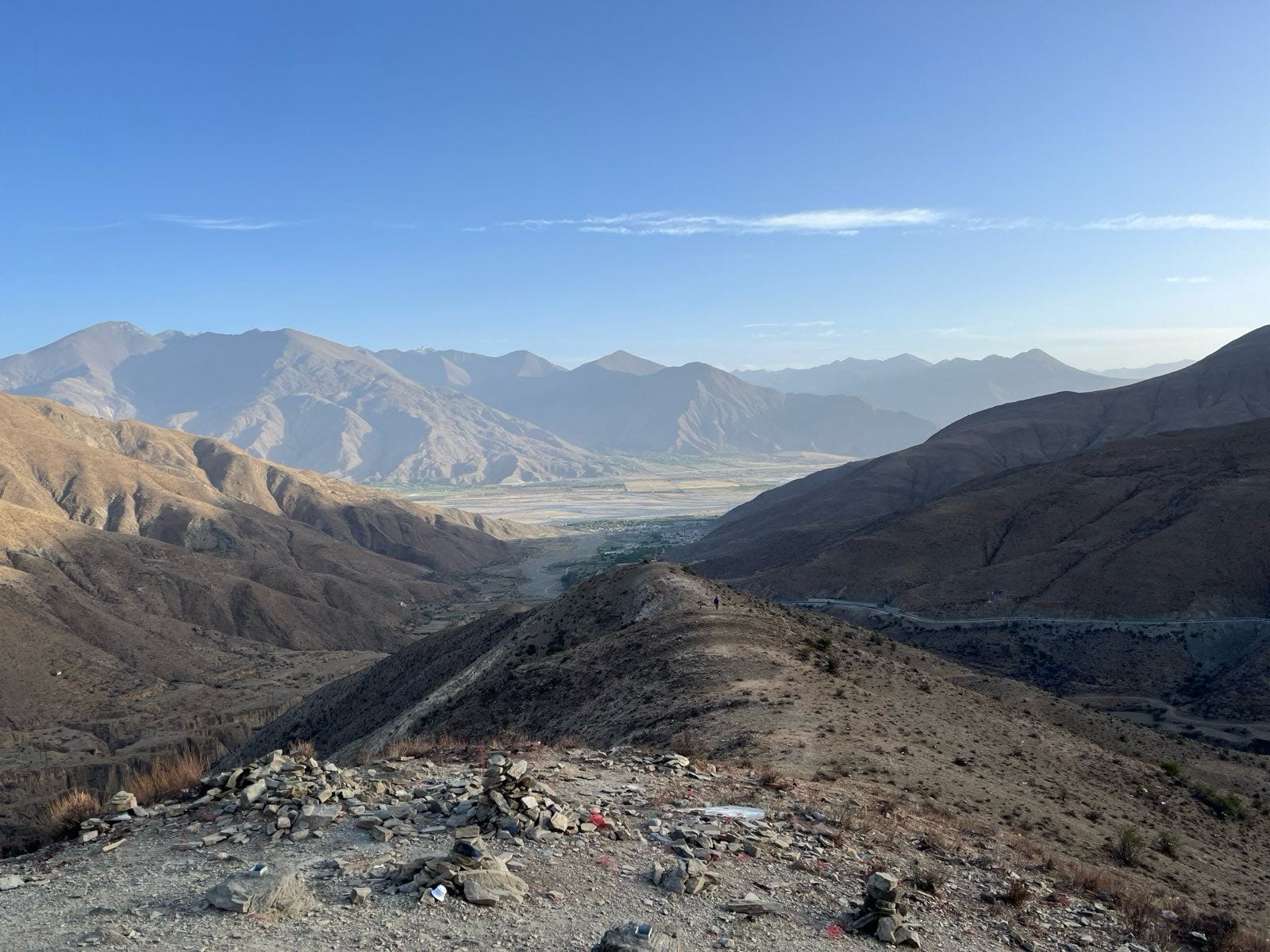
Since I was around 20, I imagined Tibet as an isolated land full of politically rebellious monks, secluded valleys, and ancient mysteries. It definitely remains one of the least accessible large inhabited areas of our planet. Unless you are a Chinese national.
To cross the forbidden frontiers of Tibet, a foreigner requires official papers featuring multiple communist red star stamps (“permits”). Only the Chinese bureaucracy can issue them. The traveller should also buy the service of a compulsory guide, complete with their car, driver, and the most luxurious (to the local standards) hotel stays.
These permit-packages start at around $500 for five days in Tibet. This is the shortest possible journey that would mean only two meaningful days in the capital: a day for arrival, another day for departure, and perhaps a day for acclimatisation. This is in a country where a cup of tea can cost you $0.1 and a good lunch around $1.
For some, I assume the most politically unstable parts, such as areas in Western Tibet that border India, Pakistan, and Afghanistan, even those multiple precautions and your guides (who may also spy on you, who knows) are not enough – only Chinese national can travel unrestricted in Tibet.
Beyond this, most foreign travellers require a Chinese visa, which would take effort to get and, as a rumour says, almost impossible to obtain if you are a journalist or academic or declare your plan to travel to Tibet. I don't need a visa, which is one of the really few advantages of my passport.
Train to the Sky
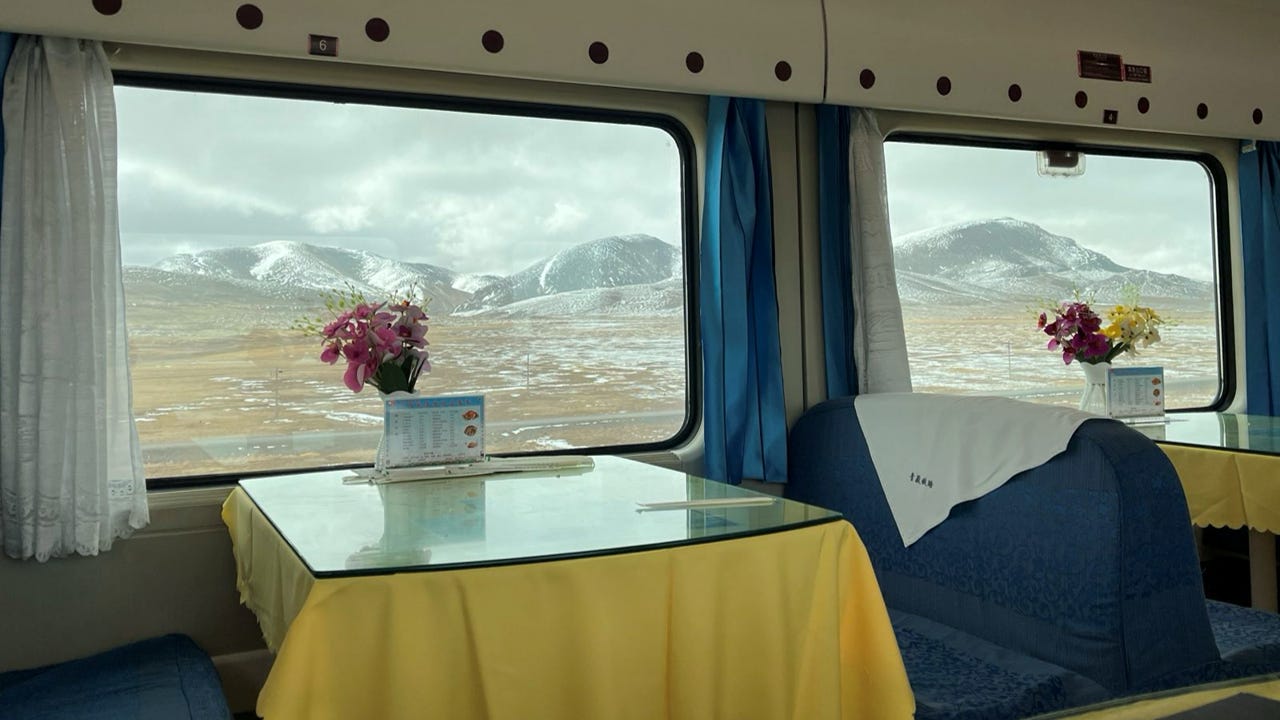
The train ride to Tibet is an adventure on its own. This train line claims to be the most elevated in the world. It takes around 20 hours for a train to traverse the Tibetan Plato to get to the capital, Lhasa. Altitude on this route rarely drops below 4,000 meters, and one of the passes that the train concurs reaches 5,702m. Everest is not that much higher up at 8,800 m. Very few people on this planet live at these Tibetan altitudes.
At night, once the train climbs to 4,000 m, the crew switches on the oxygen supply through a plane-like O2 supply system.
I wake up and find myself in the middle of a snowy desert. I feel as if I have drunk all night. I experience a headache and lack of oxygen. I hear like a young lady from a neighbouring compartment vomits in the washing basin. It is one of the typical symptoms of mild high-altitude sickness.
Two other women travellers from the Chinese province of Guangzhou decide to step down at the next station: it's already too difficult for them to sustain altitude sickness. And we haven't even reached the 5,000 m. I go to sleep again, which helps.
Foreigner means trouble
Stupid paperwork wasn't always around. Sometime after the collapse of the Soviet system and before Tibetans rebelled against Chinese rule in 2008, many foreigners travelled to Tibet. For example, two Russian students seized a moment in the 2000s and cycled around the plateau on rustic bikes they found in a Chinese city on the way.
One of them eventually dropped into a coma in the middle of the journey because of altitude sickness. The Chinese military from a nearby base saved the Russian student, and he continued his way, eventually descending into India.
These days, this journey would be impossible for a foreigner to make. The Chinese government is afraid that foreigners will contribute to the dissident movement and rebellion that occurs in Tibet every ten years or so, most recently in 2018.
As a reminder of the possibility of subversive foreign influence, the major roads in Tibet feature checkpoints bolstering signs in Chinese: ‘Do not let the spy get through!’ At one of those checkpoints, the guide takes our passports away from us ‘for our safety’, and we see them again only in a few days.
Tour operators often employ or are led by Tibetans and are likely to be sympathetic to the resistance cause. However, they require foreigners to sign a contract that requires them not to "spark political troubles." Even once this agreement is signed, tour operators cannot guarantee the trip: another “trouble” might happen at any time.
The most spectacular train journey in the world?
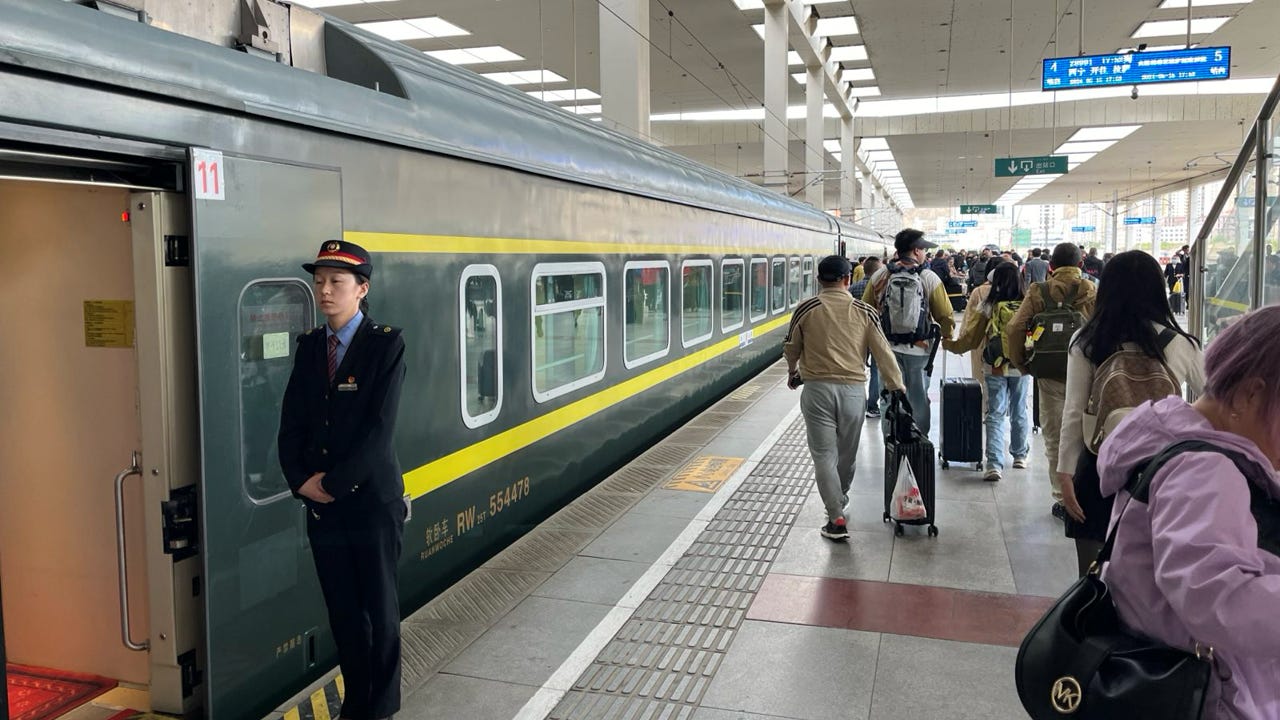
Foreign tourists have now been replaced by Chinese. Since the opening of the railway and multiple plane connections, Lhasa has become much easier for them to get into.
The two most luxurious carriages on that high-altitude train seem to be almost exclusively packed with Chinese tourists. They say they will join jeep tours from Lhasa across great ancient trade routes that stretch across Tibet and take a couple of weeks to complete.
Most fellow Chinese train passengers seem to have little knowledge of Tibet. Liu, a woman in her 40s, is different. Her piercing eyes scan the landscape with expertise. She is a Buddhist and is going on a long journey to Tibet for the second time.
Liu bursts with Buddhist terminology and plans to take a 15-day journey around the holy mountain of Kailash. Some people walk around it on foot, the most devoted – or sinned? – crawl on their knees.
There is a belief that if a person walks around the holy mountain once, their sins will be gone. If one walks two times, their future sins will be written off as well, at least for the next five years.
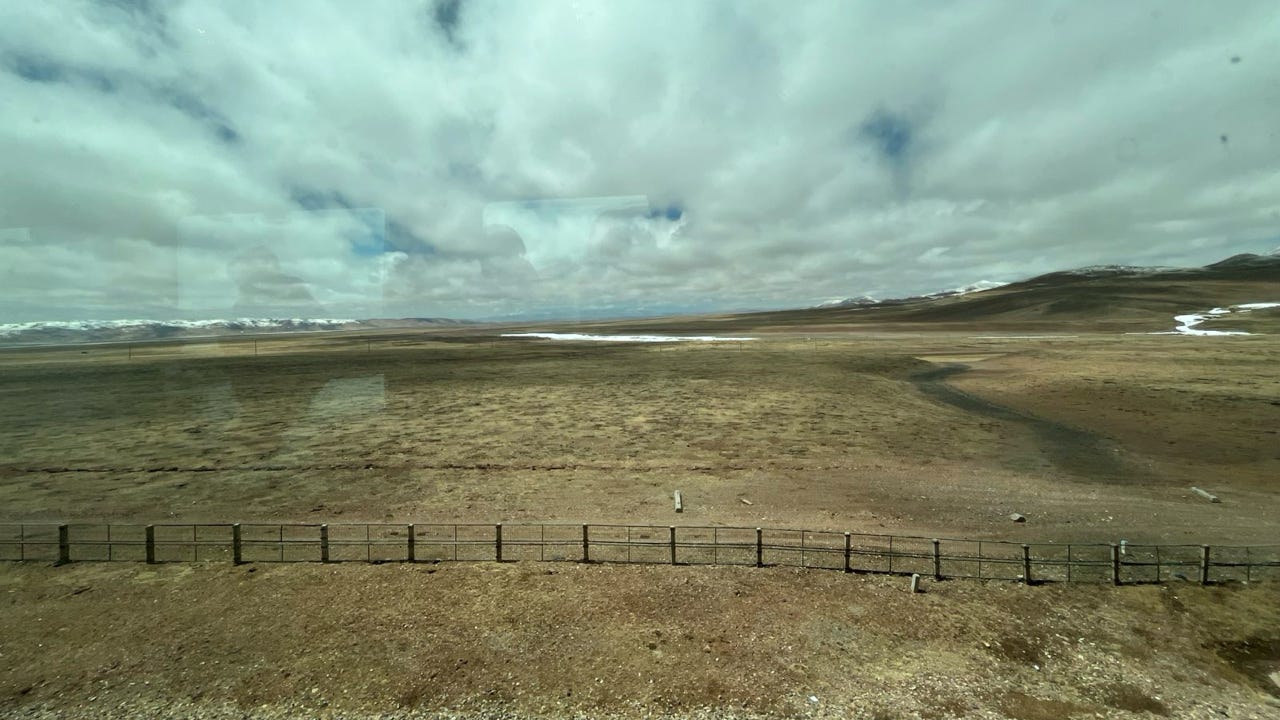
Can this be the most spectacular train journey in the world? I'm thinking of my previous visits to the mountains. I had never seen such huge stretches of almost plain land dotted with so many snow peaks at such a high altitude. I'm not sure I have ever climbed that high as well. Breathing gets difficult with every kilometre, the headache worsens, and even a few steps produce as much exhaustion as a 5-minute run.
Everyday Life in Lhasa
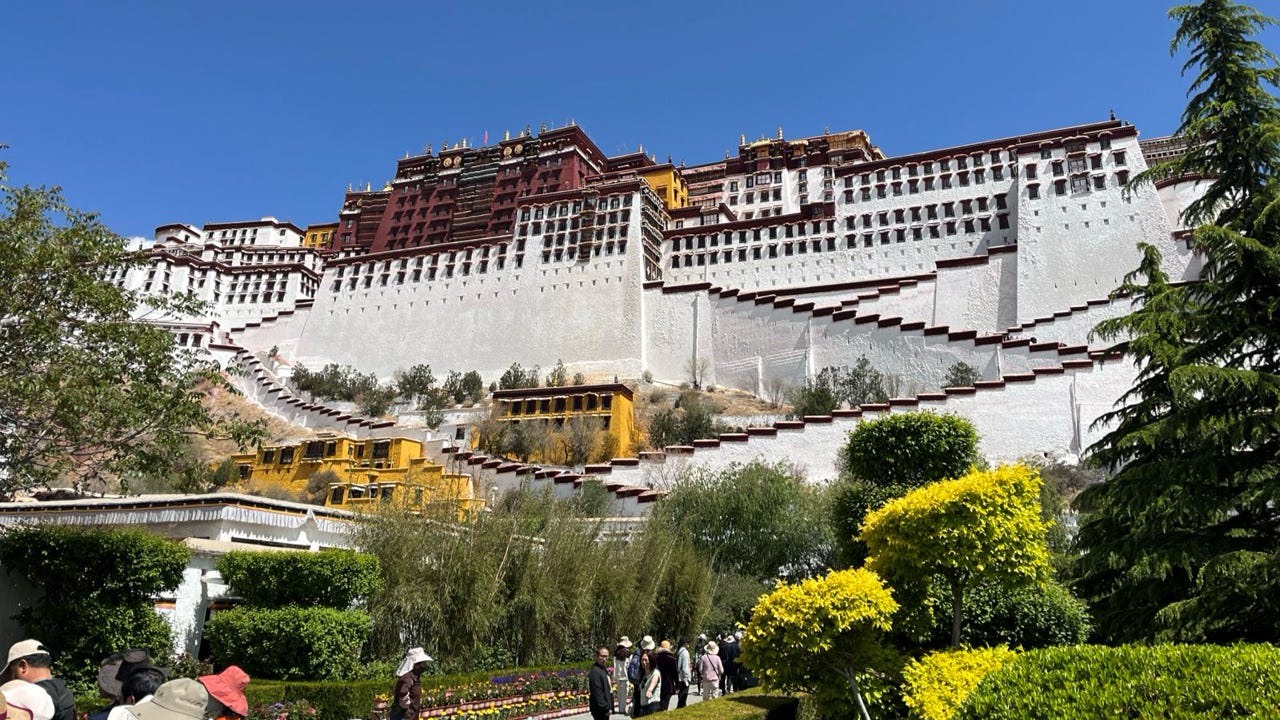
Touristic places of Lhasa where the guides bring us feel unscrupulous. An opportunity to see people's everyday life feels much more revealing and precious. We escape from our guides to see the everyday life.
Once on the street, I feel very foreign – but in a good way. Random Tibetans would smile at me and try to speak to me with their few introductory English words.
Schoolkids in their red pioneer ties seem to be especially friendly and cheerful when they notice me. You get ten smiles from a group of ten Tibetans and one smile, if you are lucky, from a group of ten Chinese. I enjoy talking to these kids on a system of smiles and gestures.
We go to a park where people dance in a circle, repeating simple movements in a traditional way (called Guozhuang Dance in China, I’ve been told), and sing, old and young alike. This feels cheerful and immediately elevates my mood.
We wander around the old Lhasa city, full of similarly-looking five-store buildings, and sit in the outdoor gym-turned playground. Kids here speak a mix of Tibetan and Chinese – a bit like Chinese migrant children in Western countries who often use Chinese and a language they learn at a local school to play with their peers.
Adults stare at their phones. Younger people dress in European clothes, while older people often prefer more traditional garments, especially females. Many bypasses have very traditional outfits.
We go to the market, where a mix of Chinese and Tibetan traders are selling very cheap stuff, mostly barley. My partner suddenly displays an amazing talent for bargaining, something I had no idea she could do.
It was fun buying stuff with her. I would select a necklace, and then she would ask about the price in Chinese. The price would often be 70% higher than what we would eventually pay. One woman asks for the price four times higher than we pay eventually.
Life in the city feels so normal under this bright and, it seems, so close sun. Or is it an illusion?
Our Itinerary
DAY 01. ARRIVAL IN LHASA BY AIR OR BY TRAIN
DAYS 2-3. LHASA’s MAIN ATTRACTIONS: POTALA, THE GREAT SERA MONESTERY, etc
DAY 04. LHASA (3656m) – GYANTSE (3977m) – SHIGATSE (3845m)
DAY 05. SHIGATSE
DAY 06. BACK TO LHASA
DAY 07. DEPARTURE BACK
Next: What I’ve seen in Tibet: