
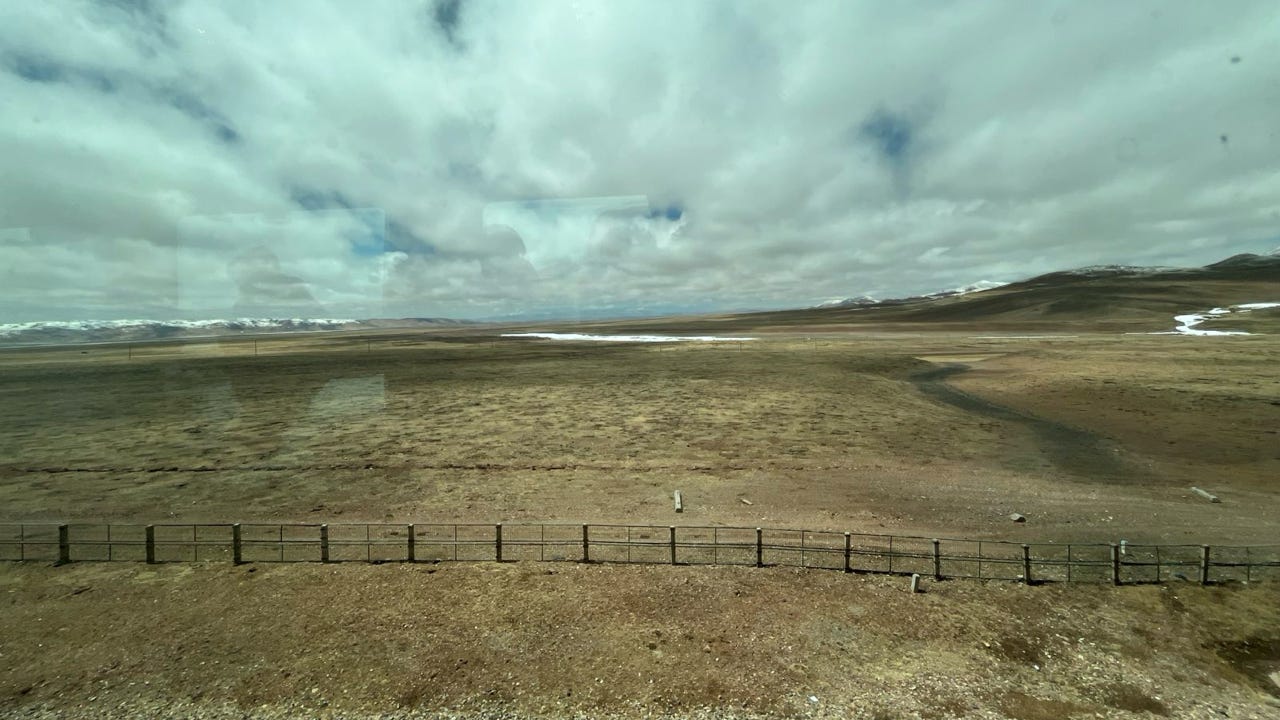
I can’t believe my eyes when I wake up on the sleeper train bound for Lhasa in Tibet after an all-night journey. From the heat of the summer of the Chinese mainland, I find myself surrounded by a great emptiness covered in snow.
This emptiness pervades surrounding unpeopled mountains with the force of a living spirit and is strangely emotionally moving.
We are approaching the highest point of the 5.5 km pass. The land outside is a barren, wind-swept plane lacking any vegetation. On the parallel highway, heavy-loaded trucks slowly traverse the hills - the only human presence in the vicinity of probably 100s km.
Here, their wild donkeys and antelopes, along with domesticated yaks, dig for grass in the snow. The endless snow-covered picks do not offer any excuse. The land screams: that's not a place for a human! Stay away!
I spend the rest of the journey staring into the windows in the hope of spotting any evidence of human lift. But there are almost no towns, and few, scattered train stations seem to be located in the middle of nowhere.
Most places around the world look quite the same: people wearing the same type of shoes and clothes, shopping with the same bank cards using similarly designed mobile phones. But there are a few places that look different, as if they remain in the 19th or earlier centuries. Some parts of Tibet are this type of places.
Fosco Maraini called Tibet of the 1940s 'perhaps the only civilization of another age to have survived intact into our own time'. He continued:
Visiting Tibet ... means travelling in time as well as space. It means for a brief while living as a contemporary of Dante or Boccaccio, ... breathing the air of another age, and learning by direct experience how our ancestors of twenty or twenty-five generations ago thought, lived and loved.
Settled farming is often impossible on the Tibetan Plateau, and its rare inhabitants are mostly nomadic people who live by their travelling herd: yaks, donkeys, and other animals that seem to be in abundance. Their large white tents, sometimes single or in groups, are often the only signs of human civilisation visible on the Plateau.
Quite colourfully dressed people, some caring children on their backs like people do in Latin America, got on the train at the 9:30 am stop.
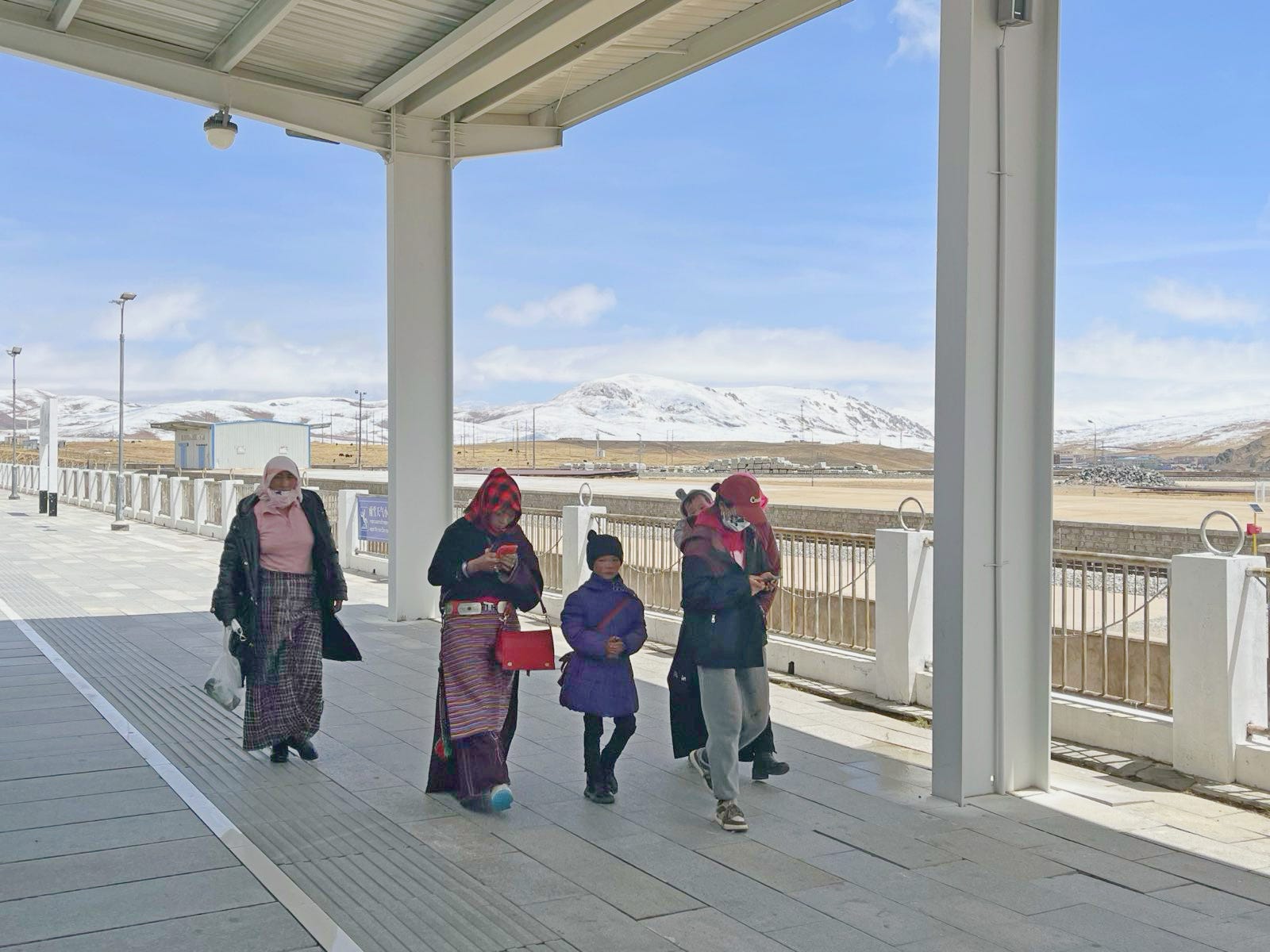
Women's faces are covered in scarves, their clothes look handmade. The ancient European jackets that many local males wear remind me of one that my grandfather wore in a Belarusian village 30 years ago when -- he would always take it on his visits to the town to collect his state pension.
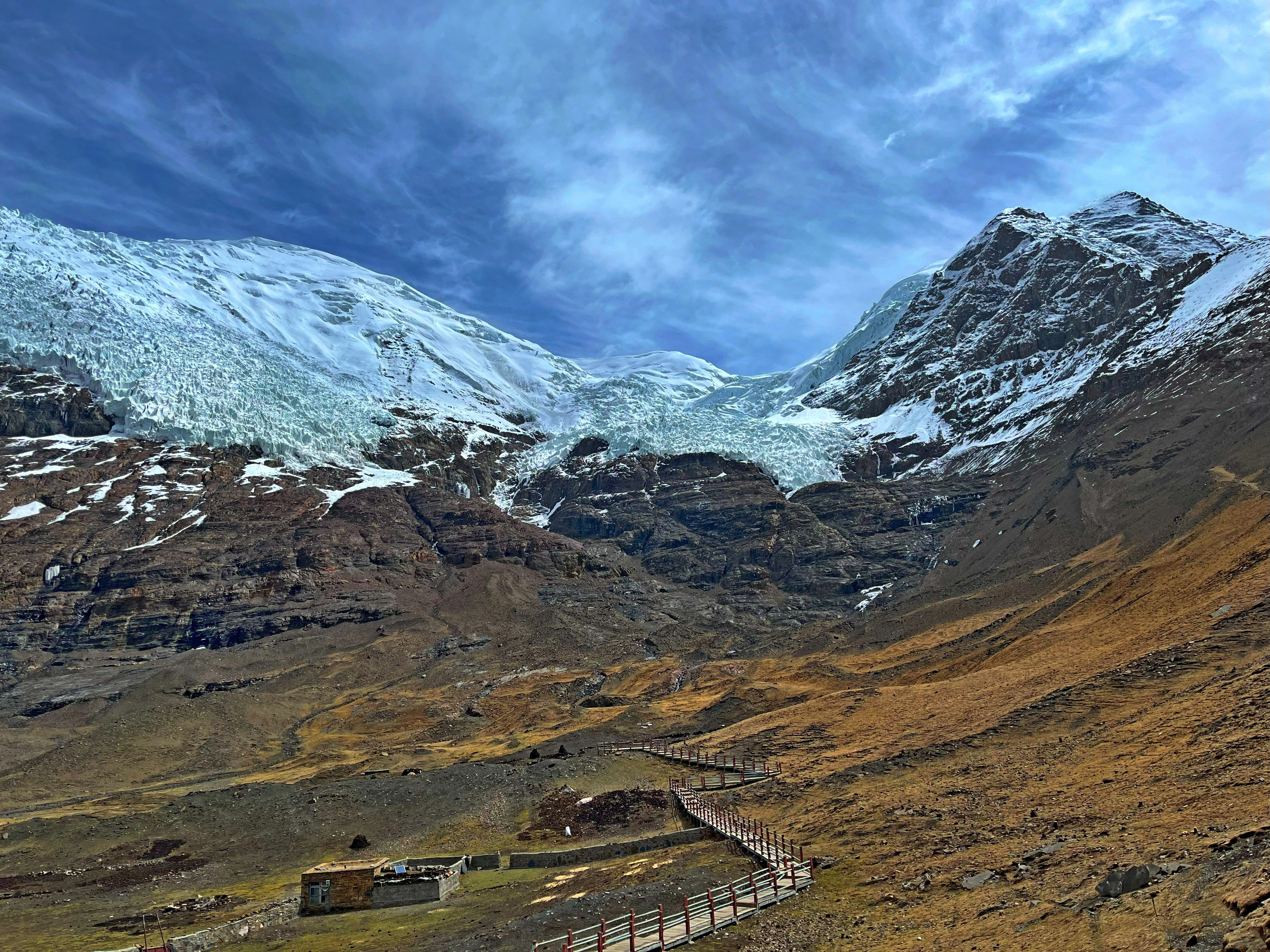
The landscape, people’s dresses, and multiple other unusual things surrounding me heavily underline Tibet’s apartness. This apartness helped Tibetans to preserve their unique culture until these days - but also made them vulnerable to any potential invader strong enough to cross the mountains and deserts surrounding this land.
I am thinking that Tibet was always famous for its geographical isolation and, frequently, for self-isolationism. The land is huge and poor, and no one was especially interested in colonising it. Just like the Chinese and the Japanese, the Tibetans banned almost any foreigners from entering their land during the colonisation era, safe for merchants and Buddhist pilgrims.
That's why Buddhist Indians serving as British superspies (known as pundits) were the first to accurately map these lands. The spies entered the country with caravans pretending to be pilgrims and used their prayer beads to count each of their steps.
“It was the winter of 1865. The leader of the caravan, bringing goods from Ladakh to Lhasa, had agreed to allow this good natured pilgrim to accompany them on the final, three-month stage of their journey to the Tibetan capital. What they did not know, and never did discover, was that this was no Buddhist holy man. Had they suspected this, and troubled to count the beads of his rosary, they would have found that there were only one hundred of these, instead of the sacred one hundred and eight.
[…]
The spies were trained by endless practice to take a pace which, whether they walked uphill, downhill or on the level, always remained the same […]. At every hundredth pace a bead was slipped. Each complete circuit of the rosary, therefore, represented ten thousand paces - five miles in the case of Nain Singh, who covered a mile in two thousand paces. Because the Buddhist rosary has attached to it two short secondary strings, each of ten smaller beads, these were used for recording every completed circuit of the rosary.
Based on the knowledge collected by the bead-counting spies, British officials drew maps later used to briefly invade Tibet from India via Himalayan passes.
Tibetans met the imperialist invaders with mostly medieval weaponry. They believed they would be victorious because their theocratic leader Dalai Lama, arranged a special prayer ceremony safeguarding the fighters from physical injuries. And in any case, as everyone knew from childhood, even if they fell in this battle, they would be reincarnated into some advantageous being.
Tibetans weren't always that defenceless. While Europe was going through the darkest ages of Medieval days, Tibetans built a huge empire and fought the Chinese so successfully that they signed a treaty on unheard-of terms. So, more than a thousand years ago, the Chinese Empire recognised the independence of Tibet, something they almost never did in relation to anyone. Tibetans then quite rightfully believed that they were the overlords of Imperial China.
I look at the window again: the emperors of China and the military might of Tibet have gone. The great emptiness is still there.
Next: The Second Truth. Occupation
Read other parts of my story of travelling into Tibet: